
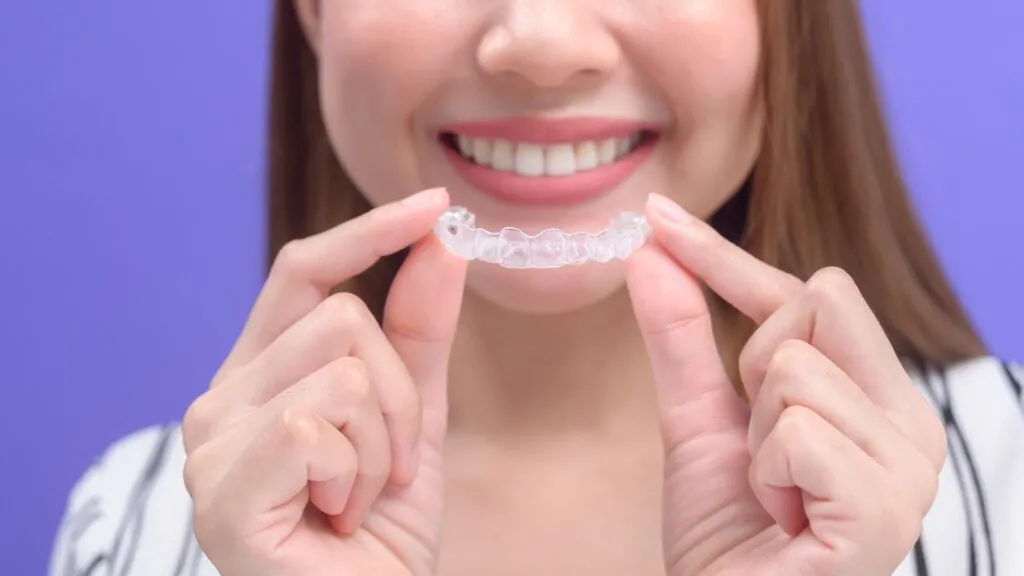
Clear aligners move teeth by applying gentle, continuous pressure to specific teeth in each tray. That pressure triggers bone remodeling: bone dissolves on the side the tooth is moving toward and rebuilds behind it. Each tray moves teeth roughly a fraction of a millimeter, and the series adds up to a straight bite.
It looks like magic when you hold the trays up next to each other. It is not. It is a controlled biological process that has been documented for over a century in orthodontics, and understanding it explains almost every rule your orthodontist gives you about wear time.
What Actually Happens Inside Your Jaw
Teeth are not set in bone like fence posts in concrete. Each root sits in a socket, suspended by a thin layer of connective tissue called the periodontal ligament. When an aligner presses on a tooth, that ligament compresses on one side and stretches on the other.
Your body responds to those signals with two types of cells:
- Osteoclasts break down bone on the compressed side, opening a path for the tooth
- Osteoblasts build new bone on the stretched side, filling in behind the tooth
This cycle is why orthodontic movement takes months rather than days, and why force has to be light and constant. Too much force cuts off blood supply to the ligament and slows everything down. Too little, or force that stops every few hours, and the bone simply rebuilds where it was.
How Aligners Deliver That Force Step by Step
Step 1: A Digital Scan Builds Your Model
A 3D intraoral scan captures the exact position of every tooth. No impression putty required. That scan becomes the starting point of your digital treatment plan.
Step 2: Your Orthodontist Plans Every Movement
This is the part patients rarely see and the part that determines the outcome. Your orthodontist decides which teeth move, in what order, how far, and how the bite will finish. Software renders it; a specialist prescribes it.
Step 3: Attachments Give the Trays Something to Grip
Small tooth-colored composite bumps, called attachments, are bonded to certain teeth. Smooth plastic cannot grab a smooth, rounded tooth well enough to rotate or lift it, so attachments create the leverage needed for harder movements.
Step 4: Each Tray Is Made Slightly Straighter Than Your Teeth
A new tray does not fit perfectly on day one, and that is the point. The mismatch between the tray shape and your current tooth positions is the force. As teeth catch up, the tray starts to feel loose, which is your signal that the stage is complete.
Step 5: Repeat Until the Bite Is Correct
Most patients change trays every 7 to 14 days on their orthodontist’s schedule, with checkups every 6 to 10 weeks to confirm the teeth are tracking the plan.
How Much Movement Per Tray?
| Movement type | Typical amount per tray | Notes |
|---|---|---|
| Straight-line (tipping) | About 0.25 mm | The most predictable movement |
| Rotation | 1 to 2 degrees | Usually needs attachments |
| Root movement (torque) | Slowest of the three | Often needs extra stages and refinements |
A quarter of a millimeter sounds trivial. Across 30 trays it is 7.5 mm of movement, which is more than enough to resolve significant crowding.
Why Wear Time Is Not Negotiable
Because bone rebuilds whenever force stops, an aligner sitting on your nightstand is not just a pause. It is a partial reversal. That is why the standard prescription is 20 to 22 hours per day, removing trays only to eat, drink anything other than water, and brush.
Patients who fall behind usually do not get a longer treatment by a few days. They get a refinement stage, which is a new series of trays ordered to recapture movement that did not happen.
Do Clear Aligners Work as Well as Braces?
For a wide range of cases, yes. Aligners handle crowding, spacing, and many bite corrections predictably. Fixed appliances still have an advantage in some situations, including severe rotations, significant vertical movement, and cases in growing children where jaw guidance matters. This is exactly the judgment call a specialist makes at your first visit, whether you are considering clear aligners or metal braces.
What Aligners Can and Cannot Do Predictably
Not all tooth movements are equally easy for a plastic tray to produce. Knowing the hierarchy explains why your plan looks the way it does.
| Movement | Predictability with aligners | Why |
|---|---|---|
| Closing small spaces | High | Simple straight-line movement |
| Relieving mild to moderate crowding | High | Combination of tipping and expansion |
| Rotating flat-sided teeth (premolars) | Good with attachments | Attachments create the grip needed |
| Rotating round teeth (canines) | Moderate | Little surface for the tray to grab |
| Extruding a tooth (pulling it down) | Lower | Plastic pushes well and pulls poorly |
| Correcting a deep bite | Good | Trays can be designed to open the bite |
| Large skeletal correction in a growing child | Limited | Growth guidance usually needs fixed appliances |
This table is also the answer to “why did my orthodontist recommend braces instead?” It is rarely preference. It is the movement list your case requires.
The Tools Orthodontists Add to Make Aligners Work Harder
Attachments
Small composite shapes bonded to teeth, angled deliberately so the tray applies force in a specific direction. Their shape and placement are prescribed, not decorative.
Interproximal Reduction
Also called IPR: a very small amount of enamel, typically a few tenths of a millimeter, polished between crowded teeth to create room. Done properly it does not weaken teeth and is often what allows crowding to be resolved without extractions.
Elastics
Yes, aligners use rubber bands too, hooked to precision cuts or buttons. They correct how your upper and lower arches relate to each other, which trays alone cannot do.
Temporary Anchorage Devices
Small titanium mini-screws placed in bone to provide an absolutely immovable anchor point in complex cases. Uncommon, but they expand what aligners can accomplish in adults.
How Long Does the Process Take?
| Case type | Typical trays | Typical duration |
|---|---|---|
| Minor crowding or relapse | 10 to 20 | 4 to 8 months |
| Moderate crowding or spacing | 25 to 40 | 9 to 16 months |
| Comprehensive case with bite correction | 40 to 70+ | 16 to 30 months |
Duration comes out of your records, not a marketing page. Anyone promising a number before X-rays is guessing.
Why Teeth Feel Loose During Treatment
Slight mobility is expected and temporary. While bone is being remodeled around a moving tooth, the socket is briefly less rigid than usual. Once movement stops and the bone finishes rebuilding, that firmness returns. This is also the biological reason retention exists: for several months after treatment, bone around the newly positioned teeth is still maturing, and nothing but a retainer holds the result while it does.
What Slows Tooth Movement Down
- Inconsistent wear. The dominant factor, by a wide margin.
- Poor tray seating. A tray that is not fully down at the back is not delivering the planned force. Use seaters.
- Untreated gum inflammation. Inflamed tissue and bone loss change how safely and quickly teeth can move.
- Smoking. Reduced blood flow to the periodontal ligament slows remodeling and stains trays.
- Clenching and grinding. Heavy parafunction can fight planned movement and wear trays quickly.
Braces vs. Aligners: The Same Biology, Different Delivery
Both appliances rely on identical biology — light continuous force, bone remodeling, and a period of retention afterward. What differs is how the force is delivered and how much of it depends on you.
| Clear aligners | Braces | |
|---|---|---|
| Force source | Shape mismatch between tray and teeth | Archwire trying to return to its original shape |
| Force continuity | Only while trays are worn | Constant, 24 hours a day |
| Depends on patient discipline | Heavily | Mainly for elastics and hygiene |
| Control of individual roots | Good with attachments | Strongest |
| Hygiene during treatment | Easier — trays come out | Harder — brackets trap plaque |
| Adjustment interval | Every 8 to 10 weeks typically | Every 4 to 8 weeks typically |
What Happens Between Tray Changes, Day by Day
- Days 1 to 2: Force is highest. Pressure and mild soreness are normal. Cells begin breaking down bone on the compressed side.
- Days 3 to 5: Soreness fades. Teeth are actively moving and the tray begins to seat more completely.
- Days 6 to 10: Movement slows as the tray approaches its designed shape. The tray starts to feel loose.
- End of stage: A tray that fits with no pressure has finished its job, which is why changing on schedule matters as much as not changing early.
This rhythm is also a diagnostic tool. If a tray never feels tight, the previous stages may not have tracked. If it never feels loose, wear time is likely short.
How Your Orthodontist Verifies the Teeth Are Tracking
Digital plans are predictions, not guarantees. At each progress visit your orthodontist compares the mouth in front of them to the stage the plan says you should be at, checking:
- Seating at the back teeth. A visible gap over the last molars is the classic sign of a tooth not keeping up.
- Attachment integrity. A lost attachment means the intended force on that tooth disappeared.
- Rotation progress on canines and premolars, the hardest movements to achieve.
- Bite relationship between upper and lower arches, which drives elastic instructions.
- Gum and enamel health, since trapped sugar under trays causes decay quickly.
When teeth have not tracked, the fix is usually one of three things: extend the current stage, go back a stage, or take a new scan and order refinements. None of those are failures; catching them late is the only real problem, which is why skipping progress visits costs more than it saves.
Myths About How Aligners Work
- “They only move front teeth.” False. Aligners move the full arch, and back-tooth movement is often what makes the bite work.
- “They are just cosmetic.” False. Aligners are used for genuine bite correction in appropriate cases.
- “Mail-order trays are the same thing.” False, and this is the important one. Remote tray services skip X-rays, a clinical exam, attachments, IPR, elastics, and in-person progress checks — all of the tools that make movement predictable and safe.
- “Wearing two trays at once speeds it up.” False and risky. Excess force slows remodeling and can damage roots.
- “Once they are straight, you are done.” False. Bone continues maturing for months, and teeth drift for life without retention.
Who Is a Good Candidate for Clear Aligners?
Candidacy comes down to the movement list your case requires and your willingness to wear the trays. Generally good candidates include:
- Adults and teens with mild to moderate crowding or spacing
- Patients with relapse after previous orthodontic treatment
- Adults with extensive crown or veneer work, where bonding brackets is less predictable
- Patients with healthy gums and no untreated decay
- People who will genuinely wear trays 20 to 22 hours a day
Cases that often do better with fixed appliances include severe rotations, teeth that need significant vertical movement, growing children who need jaw guidance, and patients who know compliance will be a struggle.
How Aligner Technology Got Here
Removable appliances to move teeth are not new; orthodontists were using thermoplastic tooth positioners decades before digital planning existed. What changed the field was the combination of 3D imaging, treatment-planning software, and mass-customized manufacturing, which made it practical to produce dozens of individually shaped trays for one patient.
The important consequence is not the plastic. It is that the plan can be designed in three dimensions and staged tooth by tooth before treatment starts. The equally important caveat: software renders a plan, a specialist prescribes it, and a mouth decides whether it happens. That is why in-person progress checks are not optional overhead.
Why Mail-Order Aligners Are a Different Product
Direct-to-consumer tray services use the same plastic and much of the same biology, but skip the parts that make movement controlled:
- No X-rays. Root position, bone levels, and hidden pathology are invisible without them.
- No clinical exam. Untreated decay and gum disease get moved along with the teeth.
- No attachments. Without them, rotations and difficult movements often simply do not happen.
- No IPR. Without space creation, crowded teeth get pushed outward rather than aligned.
- No elastics or bite correction. Front teeth can look straighter while the bite gets worse.
- No in-person progress checks. Nobody catches a tooth that stopped tracking at stage 9.
Straight-looking front teeth on top of an uncorrected bite is the specific failure mode, and correcting it afterward costs more than treating it properly the first time.
What Aligner Treatment Costs and Why
In the Riverside and Corona area, comprehensive clear aligner treatment generally runs about $3,500 to $8,000. The range reflects real variables:
| Factor | Effect on fee |
|---|---|
| Number of trays required | More stages means more lab cost |
| Case complexity | Bite correction requires more planning and visits |
| Refinements anticipated | Usually included; confirm in writing |
| Records and imaging | Often bundled into the treatment fee |
| Retainers | Should be included; ask about replacement cost |
For a full breakdown, see our guide to Invisalign in Corona, CA.
Frequently Asked Questions
Why do my aligners feel tight for the first two days?
That tightness is the force being applied. Pressure and mild soreness typically peak in the first 24 to 48 hours of a new tray and fade as the teeth respond.
Can I speed up treatment by changing trays early?
No. Bone needs time to remodel between stages. Jumping ahead usually causes trays to stop fitting, which costs more time than it saves.
What are refinements?
Refinements are additional trays made from a new scan after the first series, used to finish details or recover movement that did not track. They are common and usually included in the treatment fee.
Will my teeth stay straight after aligners?
Only with retainers. The same ligament and bone biology that allowed movement also allows drift, so retention is a permanent part of the plan.
Do attachments damage teeth?
No. They are bonded with the same materials used for tooth-colored fillings and are polished off at the end of treatment.
Curious whether aligners suit your case? Explore Invisalign for adults in Riverside, CA and schedule a free consultation.